
The page you forgot to update may be doing more damage than the page you published last week.
Table of Contents
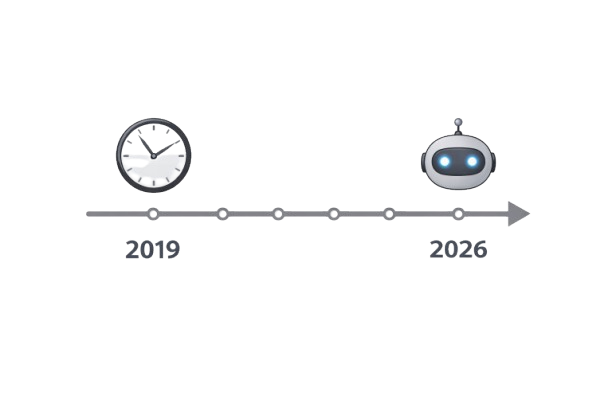
That sounds backwards at first. Most digital teams still obsess over what is new: new campaigns, new landing pages, new product launches, new quarterly content calendars. AI systems have a different memory. They absorb, retrieve, and reassemble from a much wider timeline. Which means your 2026 AI visibility may be quietly shaped by something you wrote in 2019, left untouched in 2021, and stopped thinking about in 2023.
That is the unsettling part. Content does not disappear when your team loses interest in it. It lingers in the training layer, the retrieval layer, the citation layer, and the entity layer. Old material keeps casting a shadow long after it stops receiving internal attention.
This is where the training data time machine becomes useful as a mental model. AI is not only reacting to your latest content. It is often reasoning through your historical content footprint. And that means the web remembers your outdated version of yourself long after your strategy deck says otherwise.
“Your archive is not asleep. It is still speaking.”
Why the newest page is not always the one that matters most
A lot of SEO thinking still assumes a fairly direct relationship between publishing and visibility. You create something valuable, optimize it well, earn relevance signals, and compete for current demand. That model still matters in classic search.
AI visibility introduces a second layer of reality. Large language models do not operate like a simple ranking sheet. They are shaped by prior data, retrieval systems, summarization patterns, and source associations built over time. A recent article may be excellent. An older cluster of content may still dominate the machine’s internal understanding of your brand, product, or topic.
That is the first aha moment: freshness and influence are no longer the same thing.
A brand can publish smarter content in 2026 and still get represented through weaker language from 2019 because that older material had more distribution, more crawl history, more mentions, or simply more time to become part of the web’s informational fabric.
This is where many teams misread the problem. They audit the live site and assume the live site is the whole story. AI sees a much larger residue.
The internet has a longer memory than your content team
Every company has a content graveyard. Old blog posts. Outdated comparison pages. Legacy feature pages. Event summaries from a previous positioning era. Explainers written before the product matured. Category pages built around terms nobody uses anymore.
Those pages often survive because deleting them feels risky and updating them feels boring.
So they sit there, quietly defining the brand in older language.
A software company may have repositioned itself from “dashboard tool” to “decision intelligence platform.” Its homepage reflects that shift. Its current leadership interviews reflect that shift. Its product marketing reflects that shift. Then an AI system pulls from five older pages that still describe it as “reporting software for small teams.” Suddenly the answer layer presents a thinner version of the company than the company presents itself.
That gap is not rare. It is becoming normal.
The training data time machine is really about lag
The phrase sounds dramatic. The mechanics are fairly simple.
AI systems learn from and retrieve across content created at different moments in time. Some of that content influenced model training. Some of it lives in search indexes and retrieval systems. Some of it persists through citations, mentions, mirrors, summaries, and scraped copies. Not every old page becomes important, of course. Some do. And the ones that do can freeze an outdated version of your authority.
This creates lag between who you are now and who the machine thinks you are.
That lag shows up in subtle ways. Your brand gets associated with old product categories. Your expertise gets framed through beginner-level content. Your older terminology keeps reappearing in AI summaries. Your outdated use cases survive even after your business model moves upstream.
That is why the training data time machine matters. It explains why visibility problems often feel confusing. Teams look at current content quality and ask, “Why are we still being described like this?” The answer may have very little to do with what went live this quarter.
AI does not just reward what is current. It often reuses what is established.
This is where the second aha moment lands.
The content that shaped the machine’s expectations may carry more weight than the content you hoped would replace it. That does not mean old content always wins. It means old content often gets a head start in representation.
Think about how this works in practice. A model sees repeated patterns across time: your brand name near certain concepts, your product tied to certain claims, your site linked by certain communities, your articles used as background context for a topic. Those repetitions build familiarity. Familiarity becomes default framing.
“Visibility is often historical before it becomes current.”
That line matters because it reverses how most teams prioritize their efforts. They pour energy into net-new publishing while leaving semantic debt untouched.
A realistic example: the brand that outgrew its old content
Imagine a cybersecurity company that started in 2019 selling endpoint monitoring software for startups. Its early blog strategy targeted broad top-of-funnel phrases like “what is malware,” “startup cyber checklist,” and “basic device protection.” Those pages performed well, earned links, and got quoted in industry roundups.
By 2026, the same company has moved into enterprise threat intelligence. The business has changed. The buyers have changed. The product has changed. The language should change too.
The marketing team updates the homepage, launches new case studies, publishes serious enterprise content, and refreshes sales messaging. Yet AI-generated summaries still describe the company as a startup-focused endpoint tool with educational blog content for beginners.
Why? Because the older content did more than drive clicks. It trained the web to associate the brand with a simpler identity.
Now the team has two brands at once: the one it is building and the one the machine still remembers.
This is where many companies lose patience. They assume a new messaging layer should immediately replace the old one. That is not how memory works online. New content has to compete with the accumulated residue of old content, not just with competitors.
The controversial truth: content debt may matter more than content velocity
Here is the slightly uncomfortable statement.
A lot of brands do not have a publishing problem. They have an unresolved archive problem.
That is less exciting than a new content engine. It is also more important.
Teams love velocity because velocity feels productive. Publish more. Cover more keywords. Build more topical authority. Expand the blog. Launch the newsletter. Repurpose into LinkedIn posts. All useful. None of it solves the deeper issue if your historical footprint is sending mixed signals.
In AI environments, semantic consistency matters more than sheer output. If your 2019 archive says one thing, your 2022 middle layer says another, and your 2026 strategy says something else again, the machine may average you into mediocrity.
That is a brutal outcome. Not because your content lacks quality. Because your content lacks narrative coherence across time.
“AI does not only read pages. It reads your history of meaning.”
What old content still does in 2026
It shapes entity associations
Old content teaches systems what your brand is related to. If your historical archive repeatedly connects your company to outdated products, basic concepts, or entry-level use cases, those associations linger.
It influences retrieval candidates
Even if an older page is no longer strategically useful, it may still be indexed, linked, quoted, and retrieved. That makes it eligible to re-enter the answer layer.
It dilutes topical precision
This is especially common for brands that pivoted, expanded, or narrowed their positioning. Their archive still reflects older priorities, so AI sees a wider and messier identity than the business wants to project.
It competes with your current message
Not in a dramatic way. In a quiet way. A slow way. A sentence here, a summary there, a citation choice somewhere else. Over time that drift becomes a pattern.
One indirect observation from real-world content work
You can often spot this issue without complex tooling.
Take a brand that feels sophisticated on its homepage and oddly generic in AI summaries. Then search its older archive. Very often, the older pages explain the mismatch immediately. The current messaging sounds sharp. The historical corpus sounds broad, dated, or misaligned. Once you see that split, a lot of confusing AI behavior starts to make sense.
The strange part is how rarely teams audit themselves this way. They monitor rankings, traffic, and page performance. Few step back and ask a harder question: what version of us is the web still carrying forward?
That question matters more now.
How to work with the training data time machine instead of against it
Audit your archive by meaning, not just traffic
A high-traffic old page can still be strategically dangerous if it teaches outdated associations. Look at terminology, positioning, examples, claims, and audience signals. Ask whether the page reflects the version of the company you want machines to learn from now.
Identify pages with historical authority
Some old pages have earned links, mentions, and visibility over time. Those pages deserve extra attention because they have a higher chance of lingering in AI systems. Refresh them first.
Update entity language consistently
This is where many refresh projects fall short. They change a headline and leave the body copy frozen in older language. If your product category, customer profile, or differentiation changed, update those references deeply and consistently.
Consolidate where necessary
Not every page deserves a refresh. Some deserve retirement. Some deserve merging. Some deserve redirects into stronger, current assets that better represent your expertise.
Build continuity into new content
New content should not act like it arrived from a different company. It should reinforce the language, positioning, and conceptual associations you want to strengthen across the whole domain.
Old SEO thinking versus AI reality
Old SEO often asked, “What can we rank for right now?”
AI reality asks, “What version of our brand has enough historical weight to be remembered, retrieved, and restated?”
That is a much more uncomfortable question. It forces teams to think beyond campaigns and into accumulated meaning. It turns content strategy into memory management.
And once you start seeing it that way, the archive stops looking like a storage problem. It becomes a reputation system.
This also explains why some smaller brands punch above their weight in AI visibility. Their footprint may be smaller, though it is cleaner. Fewer contradictions. Fewer outdated layers. Stronger conceptual consistency. They teach the machine a simpler story.
Meanwhile, bigger brands often carry years of unresolved content drift.
Why 2019 still decides more than people want to admit
Not because 2019 was magical. Because content published then had time to spread, settle, and compound. It was crawled, linked, quoted, mirrored, and absorbed into broader web context. It had years to influence association patterns. That kind of depth does not disappear just because a 2026 content refresh exists.
This is why the training data time machine is such a useful way to think about AI visibility. It explains why the battle is not only about being current. It is about being consistently legible across time.
Your newest page may be your best page. Your older page may still be the one teaching the machine who you are.
That leaves every content team with a sharper question than “What should we publish next?”