
Lately, while working on a few projects, I have been thinking about something that doesn’t show up in most SEO dashboards.
Rankings can stay stable.
AI visibility can still decline.
For years, we relied on rankings as our comfort metric. If positions were steady, we assumed everything was fine. Traffic forecasts seemed predictable, reporting looked stable, and nothing required urgent attention.
Table of Contents
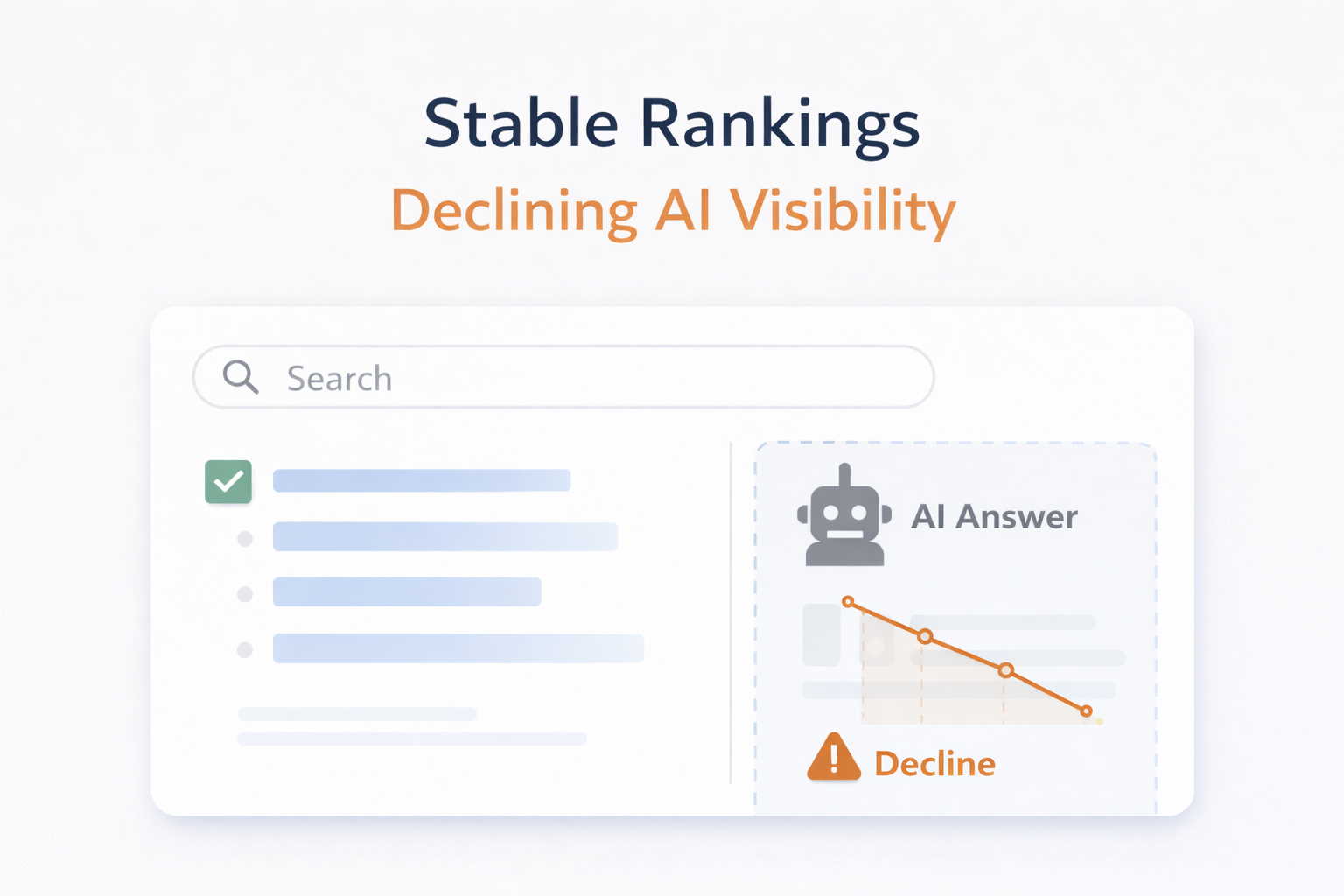
However, AI-driven search environments do not behave like traditional search.
Search engines increasingly generate answers rather than just listing documents. Systems like AI Overviews and conversational search models examine whether a page can provide an answer, not just which page ranks first.
This changes the rules.
A page can still rank well in traditional search results while slowly disappearing from AI-generated answers.
There’s no ranking collapse, no sudden traffic alert, just a gradual decline in visibility where answers are produced.
Rankings Were Designed for Retrieval
Traditional SEO was built around retrieval.
Traditional SEO focused on retrieval. A query matched with documents, and ranking systems determined the most relevant pages based on signals such as:
• keyword relevance
• backlinks
• authority
• page quality
• user signals
If a page ranked near the top, it was likely to be clicked. Therefore, ranking position and visibility were closely linked.
In that environment, optimization emphasized three basic technical principles:
• crawlability
• indexability
• relevance
As long as search engines could access and interpret the page, ranking systems could position it in the results.
But generative search adds a new step.
Before ranking matters, the system must first decide if the content can be extracted and turned into an answer. This is exactly why I introduced the concept of a citability score.
AI Systems Evaluate Extractability
AI systems do not ask which page is best.
They ask different questions.
Can I clearly understand this content?
Can I extract a precise answer from it?
Can I summarize it confidently?
This concept is often overlooked in SEO discussions.
A page might rank well due to its authority, popularity, and relevance to the query. But that does not mean an AI system can easily extract information from it.
In practice, several structural issues may prevent pages from being included in AI answers.
The content might be technically accessible but difficult to interpret. Key information may be hidden in long paragraphs without clear statements. Important insights may be implied rather than explicitly stated.
Visually appealing design can also create issues. Pages with heavy interactive elements, complex layouts, or fragmented content structures may still rank, but they complicate the extraction of clear answer blocks.
As a result, the page performs well in traditional SEO metrics while quietly losing representation in AI-generated responses.
The Silent Visibility Drop
This creates a new kind of visibility decline. Unlike ranking drops, this change rarely shows up in standard analytics. Search Console may still indicate stable impressions. Rankings may fluctuate within normal ranges. Organic traffic may remain steady.
Yet something subtle is changing
When users search questions, AI systems increasingly provide summarized responses directly on the results page. If your content isn’t included in those responses, your brand is absent from the answer itself.
Visibility has shifted from being ranked to being referenced. That difference isn’t always measurable with traditional SEO tools.
Clarity Is Becoming a Ranking Layer
In AI-driven search environments, clarity is now an important layer of optimization. For years, technical SEO ensured that pages were crawlable and indexable. Now, pages must also be structurally understandable. This means designing content that allows systems to extract answers confidently.
Several structural elements significantly enhance extractability.
Clear answer statements
Important information should be presented in direct statements rather than implied through context. For example: Instead of writing long descriptive paragraphs, use concise answer sentences that clearly state the key insight. These sentences often become extractable answer blocks.