The strange part of AI visibility is this: your brand can win the answer and still lose the visit.
That sounds backwards if you grew up in the age of rankings, blue links, and referral traffic. Yet this is exactly where many teams are headed. Their name appears inside AI-generated responses. Their product is referenced. Their research shapes the answer. Their site gets no clicks, no clear attribution, and no obvious signals in the dashboards they trust. The brand is present. The connection is missing.
“Visibility without a path is not traffic. It is borrowed influence.”
That is the gap. And once you see it, a lot of modern search strategy starts to look incomplete.
Table of Contents
The old model rewarded links. The new one rewards presence first.
Classic SEO trained us to chase a simple chain of cause and effect. Publish the page, rank for the query, earn the click. Capture the session, then measure the conversion. Links were not just part of the system. They were the system. If your page appeared and the user clicked, the value was visible. If your page did not appear, the loss was visible too.
AI interfaces disrupt that logic in a way that many teams still underestimate. A large language model takes ideas from many sources. It compresses these ideas into one answer. Then, it presents that answer clearly to the user’s question. Sometimes it cites. Sometimes it links. Sometimes it mentions a brand, a product, a framework, or a statistic without giving the user a direct route back to the source.
That creates a new layer of visibility that feels real and invisible at the same time.
You are in the answer, yet not necessarily in the journey.
That matters because users increasingly stop at the response layer. If the answer sounds complete, the urge to click drops. If your brand is mentioned there, you have influenced the outcome. If you are not linked, you may never see proof of that influence inside your analytics. The old model measured visits. The new reality demands that we measure presence before visits, and sometimes separately from them.
This is where many marketers still use old mental models on a new surface. They ask, “Did we get the click?” A sharper question is now emerging: “Did we shape the answer?”
Why “mentioned but not linked” matters more than people think
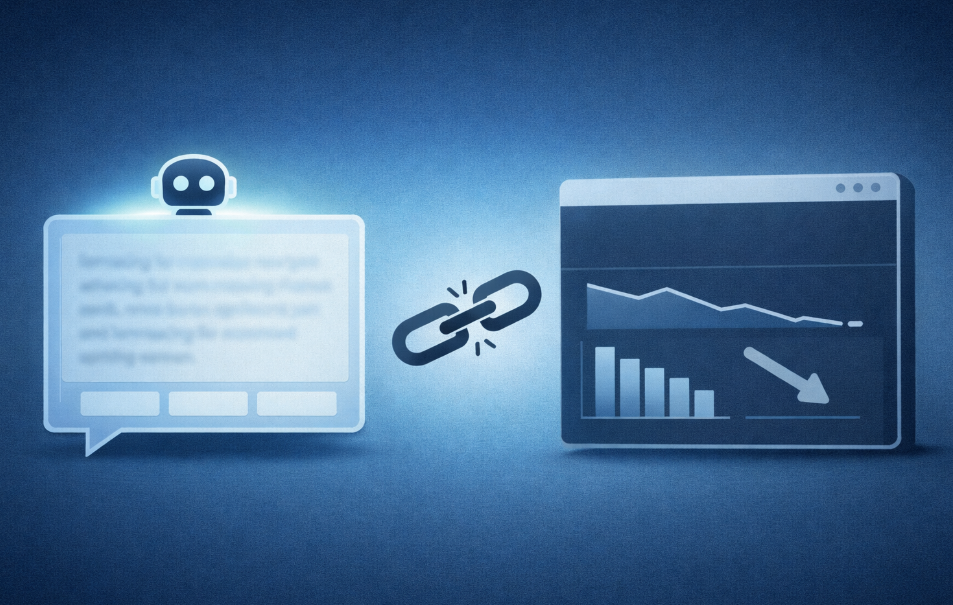
A brand mention without a link used to feel secondary. Nice to have. Good for awareness. Hard to quantify. Easy to ignore.
Inside AI systems, that same mention can carry much more weight.
A mention helps establish entity recognition. It reinforces topical association. It increases the chance that your brand becomes part of the model’s preferred language around a category. In plain English, the system starts to treat your brand as a natural answer candidate. That is a serious advantage, even when no clickable URL appears next to your name.
AI visibility is not purely a traffic problem. It is a memory problem.
When your brand is repeatedly mentioned in connection with a topic, product type, use case, or category, the system strengthens that association. Users may not click immediately. They may remember the name later. They may search it directly tomorrow. They may hear it once in ChatGPT, see it again in Google AI Overviews, then notice it later in a marketplace or social feed. Attribution gets messy. Influence keeps growing.
This is why “mentioned but not linked” should not be dismissed as a tracking inconvenience. It is a strategic signal. It shows that your content, brand, or perspective is entering the answer layer.
And here is the uncomfortable part: many teams are still optimizing as if the click is the only proof of value.
That assumption is getting expensive.
A slightly controversial truth
Future winners in AI search might get less measurable traffic. But weaker brands could benefit from better attribution pathways.
That sounds unfair. It also looks plausible. If Brand A is deeply embedded in how AI systems talk about a category, it can shape demand without owning every session. Brand B might gain more trackable clicks from comparison pages, aggregator placements, or last-touch branded searches. However, it may have less real influence on the answer ecosystem.
Measurement systems love clean referrals. Markets do not care how neat your dashboard looks.
The hidden split between the source layer and the answer layer
Most SEO teams still operate inside the source layer. They think in pages, rankings, links, structured data, snippets, crawlability, and engagement signals. All of that still matters. None of it disappeared.
The issue is that users increasingly experience the answer layer first.
The source layer is where information lives.
The answer layer is where information gets assembled.
That split changes the job. You are no longer optimizing only to be found. You are optimizing to be used.
“Ranking is retrieval. Mention is integration.”
A page can fail in traditional SEO terms and still succeed in AI visibility terms. Maybe it never ranks number one. Maybe it draws modest traffic. Yet its definitions are clean, its examples are easy to reuse, its structure is unambiguous, and its claims are specific enough to be cited or paraphrased. In an answer-driven environment, that page can punch far above its traffic weight.
This is one reason obscure sites sometimes show up in AI-generated responses while larger domains get ignored. The smaller source may simply be easier for the system to interpret and reuse.
That should force a rethink of what “high-performing content” actually means.
A realistic example: the brand that shaped the answer and missed the credit
Imagine a cybersecurity company publishes a clear guide on credential stuffing. The article avoids jargon, defines the threat cleanly, lists real symptoms, explains prevention steps, and includes a helpful example. It earns a few backlinks. Nothing dramatic. Traffic is decent, not spectacular.
A year later, users ask AI assistants questions like: How do I know if my login system is vulnerable? What causes repeated failed login attempts? How can ecommerce brands prevent account takeover?
The assistant answers with language that strongly echoes that company’s framing. It uses the same practical distinctions. It even names the brand once as a known resource in the space. There is no direct link.
What happened there?
The company influenced the answer layer. Its content became usable material. Its terminology entered the machine-readable conversation. The brand gained authority in a way that most analytics setups would undercount.
Now imagine the leadership team reviewing performance. Organic traffic is flat. Referral sessions from AI tools look minor. The page may even seem underwhelming compared with a product comparison post that gets more visits.
That is the trap. The company may be building category authority inside AI systems while its reporting framework tells a weaker story.
One real-world observation
You can already see early signs of this in how people talk after using AI tools. They often say, “I heard about this brand in ChatGPT,” even when they never clicked a source. That phrasing matters. It suggests that mention itself is becoming a discovery event.
Discovery no longer requires a visit.
Why this gap will widen
This is not a temporary quirk caused by immature interfaces. The incentives point in one direction: faster answers, fewer steps, cleaner interfaces, less friction.
Every major platform wants to reduce the work required from the user. That means summarizing, synthesizing, and pre-selecting more of the journey. Once that happens, the gap between being present and being linked naturally expands.
The brands that treat AI visibility as “SEO plus citations” are likely underscoping the challenge. Citations matter, yes. Links matter, yes. Presence without links also matters, and many teams are not set up to track or influence it.
That is where the strategic divide appears.
Some teams will keep reporting on rank, sessions, and CTR as if those metrics tell the whole story.
Other teams will start asking harder questions: Which topics does the model associate with our brand? Where are we mentioned, even without a link? Which competitor language keeps appearing inside AI answers? Which pages are easiest for systems to reuse? Are we being referenced as a product, a concept, a statistic, or a source of definition?
Those questions sound unusual today. They will sound basic soon enough.
What content earns mentions without links?
Not all content is equally reusable. AI systems tend to favor material they can interpret with confidence. That usually means clarity over cleverness and specificity over vague authority signals.
Pages more likely to influence the answer layer often have a few traits
Clear framing
The page states what the topic is, what it is not, and why it matters without drowning in unnecessary scene-setting.
Strong entity signals
Brands, products, people, and concepts are named consistently and connected to related ideas in a way that removes ambiguity.
Reusable explanations
The content contains passages that can be paraphrased cleanly into answers. Good examples, precise contrasts, and well-bounded definitions help a lot.
Original structure
Pages that introduce a useful distinction, framework, or memorable phrase often travel further than generic explainers.
This is where many SEO teams have a blind spot. They produce content optimized to rank for a keyword, not content optimized to survive compression into an answer.
That is a different craft.
What this means for SEO strategy now
The practical response is not to abandon links or rankings. It is to stop treating them as the only end state that matters.
You need content that can rank.
You also need content that can be remembered, reused, paraphrased, and mentioned.
That leads to a more durable strategy:
Build pages around entities and relationships, not only isolated keywords. Write with enough precision that an AI system can lift the core idea without distorting it. Create original language for important concepts so your framing has a chance to spread. Track brand mentions across AI surfaces, even when there is no referral data attached. Look for delayed effects such as direct searches, assisted conversions, branded recall, and repeated category association.
The deeper shift is conceptual. SEO is no longer only about owning the click path. It is about owning enough of the informational terrain that your brand keeps appearing when answers get assembled.
“Not linked” does not mean “not influential.”
That line is easy to say. It is harder to operationalize. Yet teams that learn to work with that ambiguity early are likely to build an advantage that arrives in public metrics later.
The question most teams are not asking yet
When your brand shows up in an AI answer without a link, did you lose value or gain a different kind of value first?
That question cuts to the heart of modern visibility. Many organizations are still trying to force answer-layer influence into traffic-layer measurement. The mismatch creates confusion. It also creates opportunity for anyone willing to see the shape of the next scoreboard before it becomes standard.
The web taught us to value links because links were proof of movement. AI interfaces elevate a different kind of proof: presence inside synthesis.
Once you recognize that, the goal stops being just “rank and get clicked.”
It becomes harder, more interesting, and probably more important than that.
Can your brand shape what gets said, even when nobody taps the source?