
At some point, almost every SEO team ends up relying on the same number: Domain Authority. It feels reliable. It is easy to track, easy to explain, and easy to present in a report.
That is exactly why it became so popular. At the same time, a quiet shift has been happening beneath that surface.
Domain Authority is not disappearing, yet its influence is slowly weakening. Not because links stopped mattering or because SEO lost its relevance, but because search itself has changed. The way information is discovered, surfaced, and trusted is no longer built purely on rankings. It is increasingly shaped by what gets cited. This is largely driven by how modern systems retrieve and assemble answers, especially in RAG-based search environments.
That shift introduces a different way of thinking about visibility. It moves the conversation away from where you rank and toward whether your content becomes part of the answer. This is where the idea of the Citability Score starts to make sense.
Table of Contents
What Is the Citability Score
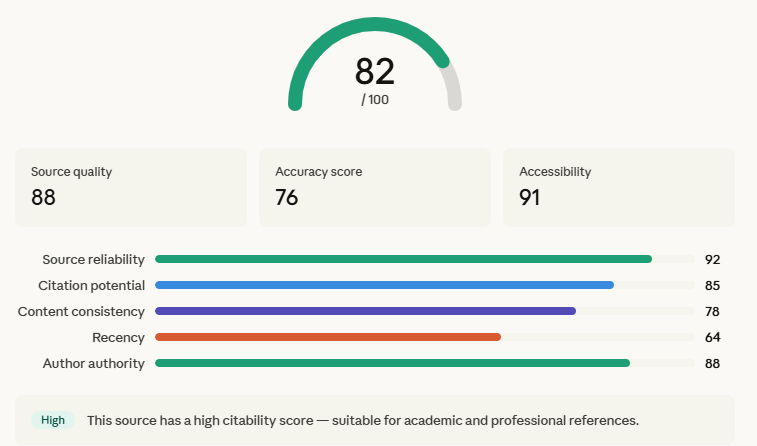
The Citability Score is a way of measuring how likely your content is to be referenced, quoted, or used as a source in AI generated answers and modern search experiences. It focuses on something deeper than rankings, something that traditional metrics struggle to capture.
It is not about how high you rank on a results page. It is about whether your content becomes the source behind the answer. That distinction might seem subtle at first, but it changes everything once you start looking at search through this lens.
In AI driven environments, users often do not click through multiple links. They read summaries, generated responses, and synthesized answers. Those answers are built from underlying sources, even if users do not always see them. Some content gets pulled into that layer. Most content does not.
The Citability Score is about understanding why.
The Shift Nobody Is Fully Talking About
There is a quiet shift happening in search, and it is easy to miss if you are still looking at traditional dashboards.
For years, SEO has been built around a simple question. How do I rank on page one? Now, the more relevant question is different. Which sources does the answer rely on?
That is not just a small change in wording. It represents a completely different system. Here is where things start to click:
Ranking is visibility, citation is influence.
You can rank first and still be invisible inside AI generated answers. At the same time, a page that does not hold the top position can become the core source behind those answers. This is not a future prediction. It is already happening across multiple search experiences.
Domain Authority vs Citability Score
To understand this shift more clearly, it helps to compare the old model with the emerging one.
Domain Authority was designed to measure link strength and predict how likely a page is to rank. It operates at a domain level and reflects the power of a site within a link based web. It works well in an environment where visibility is driven by rankings and clicks.
The Citability Score operates differently. It focuses on the usefulness of individual pieces of content and how likely they are to be selected as sources. Instead of predicting rankings, it reflects inclusion. Instead of domain level power, it looks at content level value. And instead of a click based web, it aligns with an answer based one.
Domain Authority answers one question: Can this page rank?
The Citability Score answers another: Will this page be used?
That difference may seem small, but it changes how you approach content entirely.
Why Citability Matters Now
AI systems do not interact with content the same way traditional search engines did.
They do not simply scan pages, match keywords, and return a list of links. They synthesize information, combine sources, and generate responses. In doing so, they make decisions about which pieces of content are worth including.
That selection process is where Citability becomes critical.
If your content is not selected, it does not exist in that layer of search. It does not matter if it ranks well or has strong backlinks. If it is not used as a source, it does not influence the answer.
This leads to a slightly uncomfortable realization.
In AI driven search, ranking is optional. Being cited is not.
What Makes Content Citable
Not all content is equally usable.
Some pages are easy to extract information from. Others make it difficult. Some explain ideas clearly and directly. Others bury meaning in vague or overly complex language.
Content that tends to be cited often shares a few characteristics.
Clarity plays a major role. Content that defines ideas in a straightforward way is easier to interpret and reuse. If something feels confusing to a reader, it becomes even harder for an AI system to extract meaning from it.
Specificity also matters. Generic explanations rarely stand out. Content that introduces clear frameworks, original thinking, or structured insights is far more likely to be selected. When you say something that is already everywhere, you blend in. When you say something in a distinct way, you become useful.
Structure is another key factor. Content that follows a logical flow, with clear sections and defined ideas, is easier to reference. It creates natural units of information that can be reused in other contexts.
At a deeper level, Citability is not about optimization tricks. It is about making your content usable as knowledge.
A Real World Scenario
Imagine two articles about the same topic, for example AI visibility.
Article A
- High Domain Authority site
- Optimized keywords
- Generic explanations
- No clear framework
Article B
- Lower authority site
- Introduces a new model (e.g. Citability Score)
- Clear definitions and structured insights
- Provides examples and explanations
In traditional SEO, Article A would likely win.
But in AI-generated answers?
Article B has a strong chance of being cited.
Why?
Because it adds something usable and extractable, that’s the shift.
The Hidden Layer of Search
One of the most interesting aspects of the Citability Score is that it exists in a layer most people do not directly see.
Users interact with answers, not always with sources. They read summaries and responses without necessarily clicking through to the original pages. This creates a new kind of visibility gap.
Your content might be shaping answers without generating traffic. It might influence perception without appearing in your analytics.
This is where traditional metrics start to feel incomplete. They were designed for a web where clicks were the primary signal of value. That is no longer the only layer that matters.
A Small Observation
While looking at different AI generated responses over time, one pattern becomes noticeable.
The same types of content appear repeatedly. Not always from the biggest brands or the highest ranking pages, but from sources that explain ideas clearly and structure information in a usable way.
It becomes clear that some content is written to be read, while other content is written to be used.
That difference is subtle, but once you see it, it changes how you think about content entirely.
How to Improve Your Citability Score
Improving your Citability Score starts with a shift in mindset.
Instead of focusing only on ranking signals, you begin to think about how your content functions as a source.
Start by defining concepts clearly. If you introduce an idea, explain it in a way that can stand on its own. This makes it easier for both readers and systems to understand and reuse.
Build frameworks rather than isolated pieces of content. When you give an idea a name and structure, it becomes easier to reference. It becomes something that can be cited.
Write in a way that allows parts of your content to be extracted without losing meaning. Clear sentences, logical flow, and minimal ambiguity all help.
Finally, add perspective. Content that simply repeats existing knowledge rarely stands out. Even a small shift in how you explain something can make your content more useful and more likely to be selected.