
Every marketer has felt satisfaction after reviewing a campaign report. Clicks are up, conversions look good, and the numbers seem to tell a success story.
But then a nagging question arises: Would those conversions have happened anyway? This is where a less visible layer of performance starts to matter, what I describe as the hidden metric behind product launches.
This question lies at the root of the incrementality problem. It challenges the belief that your advertising is the cause of the results you see. Sometimes, it isn’t.
Table of Contents
What Is the Incrementality Problem?
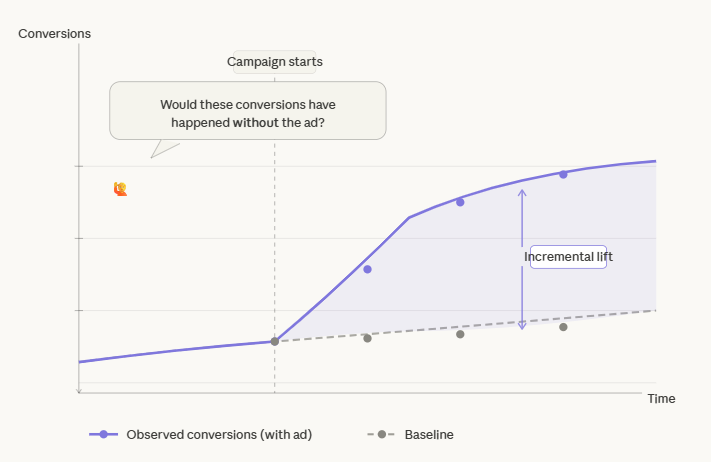
The incrementality problem helps us see if marketing creates new demand or just takes from what’s already there.
At first glance, this might seem like a minor detail. A conversion is a conversion, right? Not exactly.
Imagine someone searches for your brand name, clicks your paid ad, and makes a purchase. Most reports credit this conversion to paid media.
But what if that person was already planning to buy from you?
In that case, the ad didn’t create the conversion; it just intercepted it. Incrementality asks how many conversions are truly incremental, those that wouldn’t happen without the ad.
Why This Problem Is Easy to Miss
The incrementality problem often goes unnoticed because traditional attribution models focus on assigning credit, not questioning it.
Most platforms, like Google Ads or Meta, track clicks and conversions. They show performance metrics and attribute success to the channels they measure.
But attribution doesn’t prove causation.
Just because a user clicked an ad before converting doesn’t mean the ad caused it. The ad was simply part of the journey.
This subtlety has big implications for interpreting marketing performance.
A Simple Example
Suppose you run paid search campaigns for a well-known brand. A user searches for your exact brand name, sees your ad, clicks it, and buys.
From a reporting view, this looks like a successful paid campaign.
But let’s reconsider. Would that user have clicked on your organic result if the ad wasn’t there?
If yes, then the ad didn’t create new demand. It just redirected an existing customer.
This scenario is a common example of the incrementality problem.
The Brand Keyword Trap
Branded search campaigns often highlight the incrementality problem.
These campaigns usually have high conversion rates. Users searching for your brand have high intent.
But high performance doesn’t always mean high incrementality.
If many of these users would have converted organically, the ads’ true impact is smaller than it seems.
This doesn’t mean branded campaigns are useless. They can protect your visibility from competitors or control messaging at the top of the page.
However, their performance metrics can be misleading if incrementality isn’t considered.
Incrementality vs Attribution
It’s easy to confuse incrementality with attribution, but they’re different concepts.
Attribution answers: which channel gets credit for a conversion? Incrementality asks: did this channel actually create the conversion?
You can have a channel with strong attribution but low incrementality. This often happens when marketing overlaps with existing demand.
Conversely, channels that reach new audiences may have lower immediate attribution but higher incremental impact.
Understanding this difference helps in making better marketing decisions.
Why Incrementality Matters More Than Ever
The incrementality problem isn’t new, but it’s more relevant now.
Several factors contribute to this.
First, digital marketing is highly optimized. Campaigns often target high-intent users close to converting. This improves short-term metrics but blurs the line between capturing and creating demand.
Second, privacy changes make tracking more complex. With less visibility into user journeys, attribution models are less reliable.
Third, competition has grown. Many brands bid on similar keywords, making it harder to distinguish real impact from noise.
In this landscape, relying solely on surface-level metrics can lead to overestimating paid media effectiveness.
How to Measure Incrementality
Measuring incrementality isn’t easy, but there are methods for clearer insights.
Controlled Experiments
One reliable way to measure incrementality is through controlled experiments.
This involves splitting your audience or regions into test and control groups. The test group sees ads, while the control group does not.
By comparing outcomes, you can estimate how many conversions were driven by the ads. This is sometimes called lift testing.
Geo-Based Testing
Another method is geographic testing.
You might pause paid campaigns in specific regions while keeping them active elsewhere. If conversions drop significantly in the paused regions, it suggests the ads contributed incremental value.
If there’s little change, it may mean the ads weren’t driving new demand.
Time-Based Experiments
Time-based experiments involve pausing campaigns for a period and observing the impact.
While this method is easier to implement, it requires careful interpretation. External factors like seasonality can influence results.
Still, it can provide useful insights when used thoughtfully.
Practical Insights for Marketers
Understanding the incrementality problem can transform your paid media strategy.
Instead of just focusing on metrics like ROAS or CPA, it prompts you to ask deeper questions about each channel’s role.
Not All Conversions Are Equal
A conversion from new demand is different from one capturing existing intent. Treating them the same can lead to overinvestment in channels that seem efficient but offer limited value.
Balance Short-Term and Long-Term Impact
High-performing campaigns often target users close to converting. While important, they should be balanced with efforts to generate new demand, like upper-funnel marketing.
Look Beyond Platform Metrics
Platform metrics are useful, but they don’t tell the whole story. Combining them with incrementality testing can give a clearer view of performance.
Rethinking What Success Looks Like
The incrementality problem challenges how we define success in marketing.
Strong numbers on a dashboard can be misleading. Those numbers don’t always reflect your true impact.
Sometimes, the most valuable campaigns aren’t the ones with the highest return. They’re the ones that introduce your brand to new audiences or create demand where none existed before.
These effects are harder to measure but often more meaningful.
A Subtle but Important Shift
Once you consider the incrementality problem, it’s hard to ignore.
You’ll see the difference between capturing demand and creating it. You’ll start questioning whether performance metrics reflect reality or just a convenient version of it.
This doesn’t mean paid media isn’t effective, it often is. But its true value lies in how much new impact it generates, not just how well it captures existing behavior.
That shift in perspective can change everything.
Marketing isn’t just about being present when someone is ready to act. It’s about influencing whether they get there in the first place.