
You search for one thing, and the machine quietly asks ten more on your behalf.
That invisible expansion decides what you see, which sources get cited, and which brands quietly disappear. The strange part is this: none of those extra questions ever passed through your keyboard.
This is the Fan-Out Effect. And it reshapes visibility in ways most SEO strategies still ignore.
Table of Contents
The Search You See vs The Search That Happens
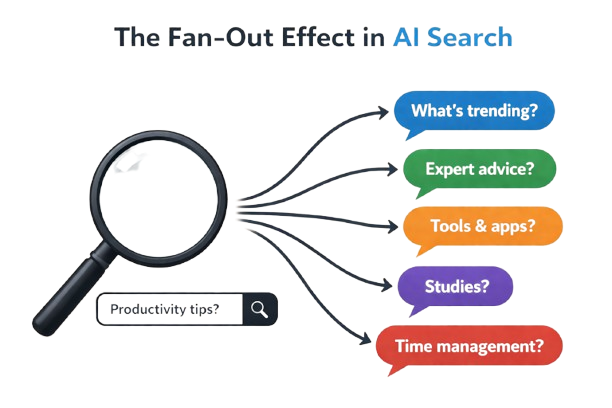
A user types a query. Clean, simple, intentional.
“Best RPG games on PlayStation.”
In traditional search, that query stays mostly intact. Google might rewrite slightly, enrich results, blend features like People Also Ask or videos. Still, the core query remains the anchor.
AI systems do not operate like that.
They deconstruct the query into intent fragments. Then they expand those fragments into multiple hidden questions:
- What defines “best” in RPGs?
- Which RPGs are currently trending?
- Which RPGs are exclusive to PlayStation?
- What are critics saying?
- What are players saying?
One query turns into a network.
This is the Fan-Out Effect.
And here’s the uncomfortable reality:
Your content is no longer competing for one query. It’s competing across an invisible cluster of derived questions.
You Are Not Ranking for Queries Anymore
Traditional SEO thinking says:
Find keywords → optimize pages → rank for those keywords.
That model assumes a one-to-one relationship between query and result.
AI breaks that assumption.
Now the system synthesizes answers by pulling from multiple sources that satisfy different micro-questions within the expanded query network.
Your page might rank #1 for the original query.
Still, if it fails to answer the hidden questions, it may never get cited.
“Ranking is visible. Inclusion is invisible.”
That gap defines the new battlefield.
From Linear Queries to Expanding Networks
Search used to behave like a straight line:
User → Query → Results
AI introduces branching logic:
User → Query → Expansion → Synthesis → Answer
Each expansion node becomes a selection filter.
Each filter removes content that lacks context.
This explains a pattern many teams struggle to interpret:
Traffic remains stable. Rankings look fine. Visibility inside AI answers drops.
Nothing looks broken. Yet something is clearly missing.
The reason sits inside the expansion layer.
Coverage Beats Precision
Old SEO rewarded precision.
Tightly optimized pages. Exact keyword targeting. Focused content.
That approach feels efficient. It also leaves blind spots.
AI rewards coverage.
Not length. Not fluff. Contextual completeness.
A page discussing “RPG games on PlayStation” that includes:
- gameplay mechanics
- narrative depth
- platform availability
- player preferences
- comparisons
…has a higher chance of being pulled into multiple expansion nodes.
A page that only lists titles may rank well, still fail to participate in AI-generated answers.
“Depth used to be optional. Now it determines existence.”
A Real Scenario You’ve Probably Seen
A gaming hub page exists.
It targets “PlayStation RPG games.”
Strong SEO basics:
- optimized title
- structured headings
- internal linking
- solid rankings
Traffic looks healthy.
Then an AI answer appears for related queries.
The answer includes:
- comparisons between RPG types
- recommendations based on play style
- short summaries of top games
- contextual explanations
The hub page barely gets cited.
Why?
It answers the main query.
It does not answer the expanded questions.
This creates a silent loss. No ranking drop. No obvious issue. Still, visibility shrinks inside AI-generated layers.
The Subtle Shift in What “Relevance” Means
Relevance used to mean alignment with a query.
Now it means alignment with a reasoning process.
AI does not just match content. It evaluates usefulness across multiple inferred intents.
This introduces a new kind of mismatch:
Content can be relevant in isolation, yet irrelevant in synthesis.
A page might answer “what” perfectly.
The system also needs:
- “why”
- “how”
- “which one to choose”
Without those layers, the page becomes incomplete inside the AI’s reasoning path.
The Slightly Uncomfortable Truth
Most SEO content today is optimized for questions users ask.
AI systems optimize for questions users never thought to ask.
That creates a widening gap.
“Search is no longer reactive. It’s anticipatory.”
And that anticipation defines visibility.
Fan-Out Effect in Practice: What AI Actually Does
Let’s take a simple query:
“Is Elden Ring worth playing?”
An AI system might expand this into:
- What type of game is Elden Ring?
- How difficult is it compared to other RPGs?
- What do critics say?
- What do players say?
- Is it suitable for beginners?
- What are alternatives?
Now imagine your content only answers one of those.
You are competing against sources that collectively answer all of them.
The system builds an answer using fragments.
You either contribute to those fragments, or you disappear from the final output.
Why Traditional Keyword Research Feels Incomplete
Keyword tools still provide value.
They show demand. They show trends. They show volume.
They do not show expansion logic.
They do not reveal:
- derived questions
- hidden intent clusters
- reasoning paths inside AI systems
This leads to a common misalignment:
Teams optimize for visible queries.
AI systems prioritize invisible ones.
The result is a strategy that feels correct, yet underperforms in emerging surfaces.
What This Means for Content Strategy
The goal is no longer to target a keyword.
The goal is to satisfy an ecosystem of questions.
This requires a shift in how content is planned:
1. Think in Clusters, Not Pages
Each topic should cover:
- core concept
- comparisons
- edge cases
- decision guidance
Not as separate pages scattered across a site. As interconnected layers within a coherent structure.
2. Build for Answer Extraction
AI systems pull fragments.
Clear, well-structured explanations increase the chance of being selected.
Dense paragraphs with no hierarchy struggle here.
3. Anticipate Follow-Up Questions
Every query implies a next question.
If your content does not answer it, another source will.
This is where the Fan-Out Effect creates winners and losers.
A Quiet Observation From Real Workflows
Content teams often refine pages after performance drops.
In AI-driven environments, the signal appears earlier.
Pages that look strong in traditional metrics fail to appear in AI summaries.
No alarms trigger.
No clear error surfaces.
Only a subtle absence.
Once you notice it, you start seeing it everywhere.
The New Visibility Model
Visibility used to be measured by:
- rankings
- clicks
- impressions
Now there is another layer:
Presence inside generated answers.
This presence depends on:
- contextual completeness
- clarity of explanation
- alignment with expansion nodes
A page can rank high and still be invisible in AI-driven discovery.
That dual reality defines the current transition.
Three Short Lines Worth Remembering
“You are not optimizing for queries. You are optimizing for reasoning.”
“What gets cited is not what ranks. It’s what completes the answer.”
“Visibility now happens inside answers, not before them.”
Where This Leaves SEO Teams
This shift does not remove the need for fundamentals.
Technical SEO still matters. Structure still matters. Authority still matters.
The difference lies in how content is evaluated.
Instead of asking:
“What keyword are we targeting?”
The better question becomes:
“What questions does this page allow an AI to answer?”
That perspective changes how briefs are written, how content is structured, and how success is measured.
A Final Thought That Feels Slightly Early
Most teams are still optimizing for what users type.
The systems shaping visibility are optimizing for what users never type.
That gap will not stay small.
The interesting question is not whether the Fan-Out Effect exists.
It’s how long strategies can ignore it before visibility starts slipping in ways that are hard to explain.